
97% of studio leaders have used AI in some form during development, with 94% having used AI in at the least one of the 9 manufacturing levels.
This knowledge comes from a brand new AI adoption report by consultancy agency Vivrato, based mostly on 101 interviews with studio leaders in Europe and North America carried out between April and September 2026.
The interviews addressed six sorts of AI: generative AI, rules-based automation, fine-tuned or custom-trained fashions, classical machine studying, retrieval-augmented programs, and agentic programs.
Vivrato clarified {that a} “studio’s view of generative AI is not handled as its view of AI general.”
Among the many 9 manufacturing levels, AI is mostly used in code and engineering (engine, instruments, gameplay code) at 86%, adopted by basic productiveness duties (equivalent to documentation, e mail, conferences, and planning) at 83%, and idea and pre-production (ideation and brainstorming) at 79%.
Design and prototyping (mechanics, programs, options) use is 68%, whereas artwork, belongings, and animation (characters, environments, movement seize) are at 60%.
Greater than half of studios use AI for QA and testing, in addition to for narrative and world constructing. Analytics and participant knowledge, together with LiveOps and monetisation, have the bottom AI adoption charges.
Over half of respondents price the mixing of AI into the total manufacturing pipeline at three or decrease out of ten.
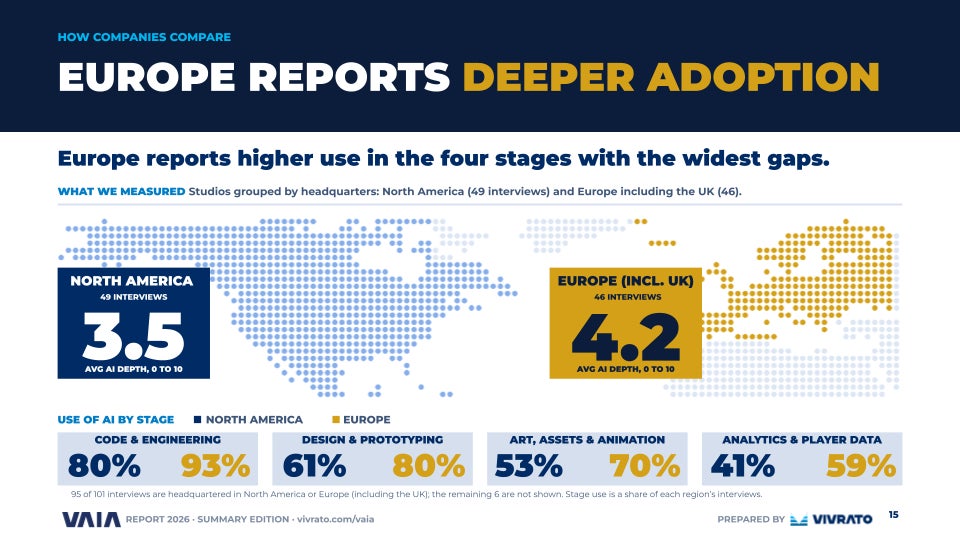
European studios report deeper AI adoption, with a median self-rated pipeline integration depth of 4.2 out of 10 (together with the UK), in comparison with 3.5 out of 10 in North America.
European studios use AI greater than their North American counterparts in code and engineering, design and prototyping, artwork, belongings and animation, and analytics and participant knowledge.
“The fascinating query is not round which recreation studios are utilizing AI anymore,” stated Vivrato founder and CEO Adam Boyes. “Most of the leaders we spoke with declared that they’ve adopted some form of AI inside their development pipelines.”
“The main focus is now the place they’re utilizing it, what’s altering, what’s truly serving to, and the place groups are nonetheless working into challenges.”
Boyes added: “We have observed this 12 months, public discourse and definitions about AI in video games normally defaults to generative AI: chatbots, picture era, and artificial voices.”
“Nonetheless, we all know that studios use AI in a spread of methods, from machine studying that predicts participant churn to rules-based automation in testing, with very totally different outcomes – that makes now the proper second to set a transparent baseline.”
Earlier this week, Sheridans associate Anna Poulter-Jones supplied an summary of the present legal guidelines surrounding AI in recreation development.