
The New York-based PR and advertising and marketing company Sandbox Strategies was based in 2005. Now, as the corporate celebrates its twentieth anniversary – and as senior PR director Valerie Norton prepares to take over as firm head from co-founder Rob Fleischer – it is an opportunity to have a look at how the enterprise of PR has developed over the previous two decades.
So much has modified. On the outset, the main target was on print media, events, and bodily video games, with a lot of the job involving travelling to shops, press places of work, and studios. That has slowly shifted to the purpose the place virtually every little thing can now be finished on-line, and influencers have lengthy since displaced conventional media because the avenue of alternative for entrepreneurs in terms of selling video games.
Right here, Norton and Sandbox co-founder Corey Wade (who left the agency to turn out to be head of enterprise growth at Saber Interactive in 2021) reminisce about how the character of video games PR has modified irrevocably because the early 2000s, in addition to classes discovered from decades in the advertising and marketing trenches.
To start with
Sandbox Strategies was based in 2005 by Invoice Linn, Rob Fleischer, and Corey Wade. All three had beforehand labored at Rockstar Video games, with the identify reminiscent of the sandbox expertise supplied by GTA.

“Working at Rockstar was nice,” recollects Wade, who was a senior product supervisor on the firm, working on titles like State of Emergency and Midnight Membership. “They blew up throughout these years, it was superior. However I acquired burnt out, and Invoice and Rob needed to maneuver on.”
The thought with Sandbox was to mix advertising and marketing and PR, with the PR aspect of the enterprise constructing pre-launch hype, and the advertising and marketing aspect taking up at launch. Wade says they had been below the phantasm that as a result of the three of them had labored with Rockstar – “and Rockstar are so cool and they’re so profitable” – individuals could be queuing up to make use of their companies. “However no, no person cared. So we began from nothing, with no matter purchasers we may get, and simply kind of went from there.”
Codemasters was an early consumer, and Sandbox was charged with advertising and marketing the Colin McRae rally video games in the US – the place nobody had heard of Colin McRae and few had been conversant in rallying as a motorsport. The franchise was renamed Dust, and Wade had the thought of bringing in the American rally driver Ken Block. “He began making these wild movies known as Gymkhana, and he began getting actually in style,” recollects Wade. “So it was excellent as a result of Codemasters wanted one thing contemporary for America. And so I acquired maintain of Ken Block and launched him to Codemasters – and should you have a look at the duvet of Dust 2, it is Ken Block’s automobile. Then Dust 3 was full-blown ‘Ken Block: The Game’.”
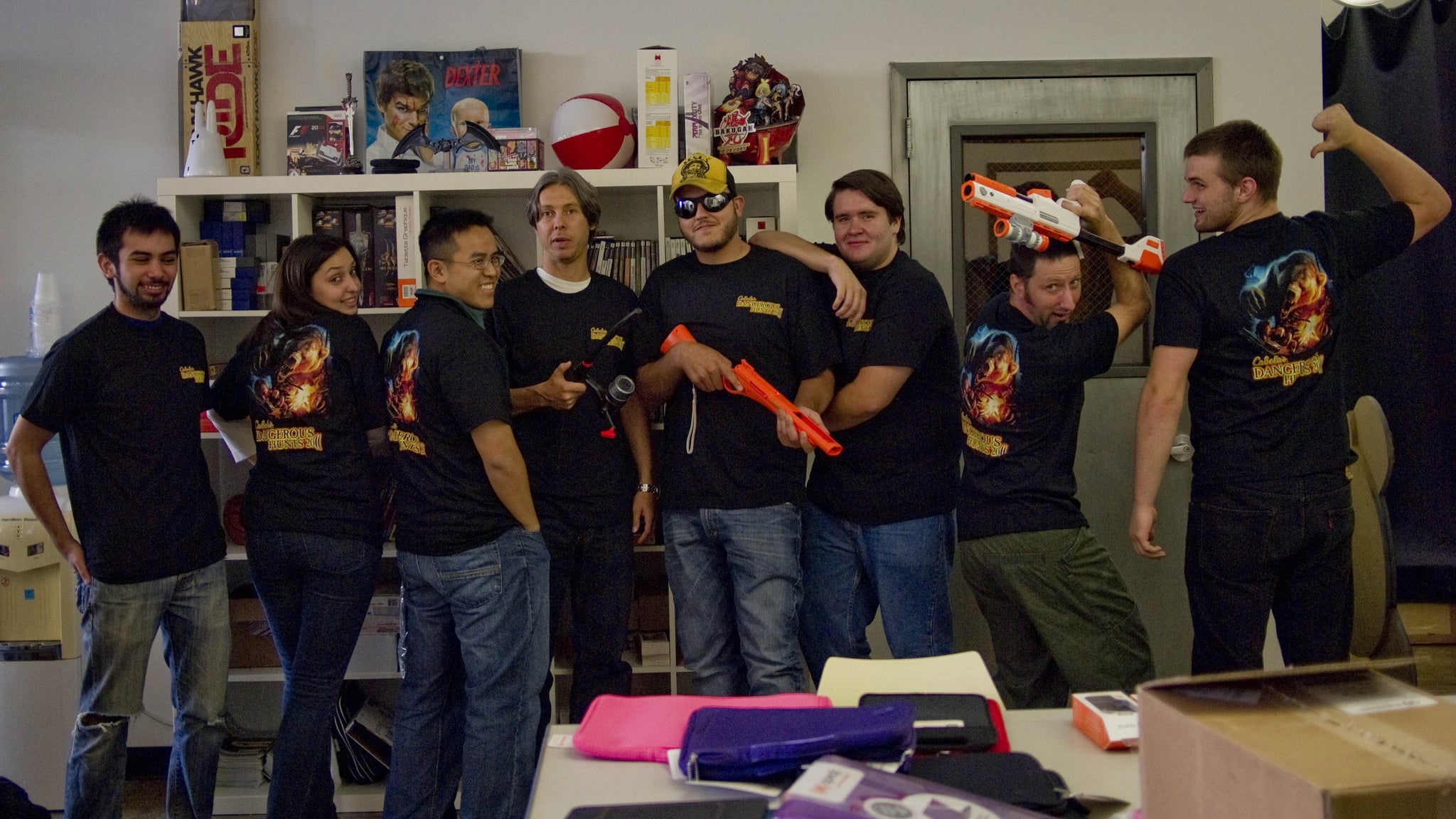
Activision’s licensed video games division was one other early consumer, with Sandbox working on titles just like the long-running Cabela’s Big Game Hunter franchise. “These video games had been enjoyable to work on,” says Wade. “They weren’t players’ video games, they don’t seem to be successful awards, however they bought, and that sure sort of viewers liked it. The Walmart viewers liked it.”
Not each sport was a winner. Wade says that the various, many video games Sandbox has promoted down the years have ranged from “being piss poor to being actually iconic”. In the end, he says, it is about taking “each mission for what it’s” and making an attempt to get pleasure from it. “If the individuals are cool, that is an important factor. I would a lot slightly work on some sport that is perhaps not going to win each award over some 9 and a half out of 10 sport on IGN the place the boss of the studio is an entire loopy man.”
In the long run, it is a individuals enterprise, and not about basking in the mirrored glory of a critically acclaimed or profitable title. “Why would you affiliate your self-worth with a sport?” asks Wade, who says when he thinks again to his time at Rockstar, he remembers the individuals slightly than the video games they labored on.
It is perhaps good by launch
However what does it really feel like to advertise a sport that you recognize is unhealthy?
Norton factors out that early on, on the level when Sandbox is introduced in, it may be troublesome to understand how a sport will end up. “Numerous instances, it is sort of this religion that issues will come collectively by the top,” she says, noting that some titles solely actually turn out to be enjoyable in the ultimate throes of growth.
“There’s this hopefulness. I feel we would like all of our video games to be good, or a minimum of if they don’t seem to be for everybody, a minimum of they discover somebody on the market who loves it. However there’s instances the place the hype has gone so excessive, it is virtually not possible to succeed in that.”

Norton says the corporate makes use of mock reviewers to evaluate early builds, and communicates any worries a couple of sport to the studio’s administration. “I at all times say, I’d slightly a consumer hear it from me as their PR particular person than in six months, when it is reside, from a journalist.”
When coping with a brand new consumer, Norton says they’ll rigorously consider the sport to resolve the way it’s shaping up, in addition to whether or not it is the correct match. “There’s been instances the place we have simply mentioned, ‘Hey, it is a actually troublesome market, it is actually crowded, we do not suppose we’re the correct individuals for this’,” she says. “We’ll say, ‘Do not work with us, use your cash in direction of one thing else’. As a result of we do need them to succeed. This can be a small trade, and we’d slightly inform them what they should hear, and we’d slightly work on video games that we predict we may do effectively with.”
Occasion over
Wade says that the wild PR excesses of the Nineteen Nineties had been principally over by the point Sandbox began in the mid-2000s. Again in the times of print media, when it was all about getting “these 5 massive articles in the 5 massive magazines,” the wild spending on press journeys and events made sense, says Wade.
However one factor that did not change instantly was the heavy focus on bodily retail. “It was all about producing this protection so individuals may go go to Walmart, GameStop, or Greatest Purchase,” recollects Wade. Mixed with this, there was a woeful lack of metrics for monitoring the hype and potential gross sales of titles forward of launch. “It was like, ‘Have a look at this text in this journal, belief me, individuals are loving this’. However no person may measure something.” There was no level relying on YouTube views as a information, as a result of YouTube had solely simply began a number of months earlier than Sandbox launched.
The main focus again then was on pre-orders. “You could not get a retailer to take a correct order for a sport until pre-orders had been on a sure trajectory,” says Wade.
It is troublesome to think about now, however the entire enterprise as soon as revolved round discs in bins. “I keep in mind the workplace was simply stacked with hundreds and a great deal of bodily product,” remembers Norton. And though displaying video games to the press remains to be a mainstay of PR in the present day, the way in which it is finished has modified dramatically. “Again then it was so centralized in San Francisco, with quantity of journalists in New York as effectively, that you may do a tour and see a ton of individuals in a day,” says Wade. “Nowadays it is simply not like that. Persons are in every single place.”
“Again in the day, it was somewhat bit less complicated, as a result of there have been these media centres and this rhythm of selling video games: whenever you first exit, whether or not you pitch for a canopy, whenever you do a second function, all that stuff was set in stone for a short time. However these years of 2005–10, it was transferring on-line, the place these issues slowly began to dissipate. Then a pair years later, it was the rise of Twitch and YouTube.”

Norton began at Sandbox in 2015, transferring throughout from a unique company, and she remembers the preliminary confusion about methods to take care of influencers and on-line creators. “It was all utterly flying by the seat of our pants,” she says. “It was all natural, no person was getting paid.”
The brand new influencer panorama felt unfamiliar. “It was sort of a wild west in a means, ” says Norton. “Working with conventional media, there have been guidelines, proper? There is a code that journalists work by. There’s embargoes and there’s NDAs. And this was new to individuals who had been simply streaming from their bed room. There have been no guidelines.”
“I felt prefer it was wholesome although,” provides Wade. “As a result of that they had power, they had been fans… You simply sort of regulate to it and be taught the scene, and I feel finally it ended up being a pleasant injection of constructive power. There’s some destructive, however far more constructive than destructive in terms of streamers.”
Digital PR
The massive modifications got here with the COVID pandemic. Sandbox used to have a number of places of work in New York, in addition to one in San Francisco, however the want for bodily workplace house has now virtually disappeared as sport demos and conferences have moved on-line.
“For about 5 years, we had a fantastic, out-of-a-movie, concrete-floor loft workplace in New York, with a demo room and all these items,” says Wade. “It was superior, however it acquired to the purpose the place it was similar to, we do not actually do not do occasions right here all that always, and individuals make money working from home – and it was simply costly.”
The enterprise as a complete has turn out to be a lot much less centralised because the pandemic, says Norton. “We work with much more contractors as of late than ever, and they’re in every single place. And in a bizarre means, I do sort of like that, as a result of we get to work with individuals who perhaps we by no means would’ve labored with, as a result of they would not have had the means to maneuver to San Francisco or New York or London.”
“As every little thing grew to become so digital, it gave us an opportunity to have a look at different locations to rent individuals. We had our first worker out in the UK, we’ve got one now in Sweden. We have had individuals in Idaho and Florida.”
Gaffe prevention
We will all consider instances when corporations have dedicated legendary PR gaffes. “However there are such a lot of extra instances that I can consider that we solved them earlier than anybody ever came upon,” says Norton. “A few of our purchasers have had concepts, and we had been like, ‘Oh no’.”
The general public a part of PR is what will get printed or what will get shared on-line. However what occurs behind closed doorways – and what’s prevented from exiting these doorways – makes up a big a part of a PR’s job. “There’s a lot extra nonsense and craziness that we see on our aspect that by no means makes the sunshine of day – and it is our job to maintain it that means,” says Norton. And naturally, she is not in a position to share any of these juicy tales right here, unhappy to say.

However she’s very happy to speak about Sandbox’s successes, and Baldur’s Gate 3 is the sport that instantly springs to thoughts. “That’s far and away probably the most recognizable video games that Sandbox has labored on. And I imply, speak about runaway success, proper? It simply broke by way of every little thing and went on to win each single Game of the 12 months award.”
Different highlights embrace Simply Trigger 3, Fall Guys, Hunt: Showdown, Mouthwashing, and Telltale’s numerous video games, like The Strolling Useless. Norton notably remembers a recreation of the Batcave in a hidden room at E3, made to tie in with Telltale’s Batman sport. “That was unbelievable” she says.
“It was even enjoyable working on Offended Birds,” provides Wade. “We labored on the ten 12 months anniversary and did all types of enjoyable stuff. That they had this fancy advert company that we may work with, and they ended up making these bizarre scooters. You would scream into them to go quicker.”
The media and PR panorama has modified dramatically over the two decades of Sandbox’s existence, and Norton thinks this transformation will solely proceed. “We’re seeing the rise of blogs which might be coming from individuals who had been previously in video games [media] and who at the moment are embarking into extra impartial journalism,” she says, giving Aftermath and Second Wind as examples. “We’re seeing extra newsletters and issues like that.” So though the media panorama typically feels prefer it’s shrinking, she says, “I feel it is finally altering.”

Different territories are additionally on the rise. “We work much more with Latin America than we ever did,” says Norton, saying that media retailers there have begun to strategy them. “And we had been like, wow, there’s an enormous alternative right here. Why aren’t we working with them proactively? In order that’s been an enormous change that I’ve helped spearhead on the firm.”
AI is one other change, in addition to a problem. “We as a staff had an offsite [meeting] in June to agree on our stance on how we strategy AI,” says Norton – however provides that due to how briskly the expertise is altering, that stance might need to be revisited once more and once more. “In six months, there might be a very completely different alternative, a unique use case.”
In the long run although, she thinks one factor in regards to the PR enterprise by no means modifications. “It is nonetheless finally about individuals. And that is what it is at all times going to be.”