
Large Squid launched its third recreation, Sword of the Sea, in August this 12 months, following on from Abzû in 2016 and The Pathless in 2020.
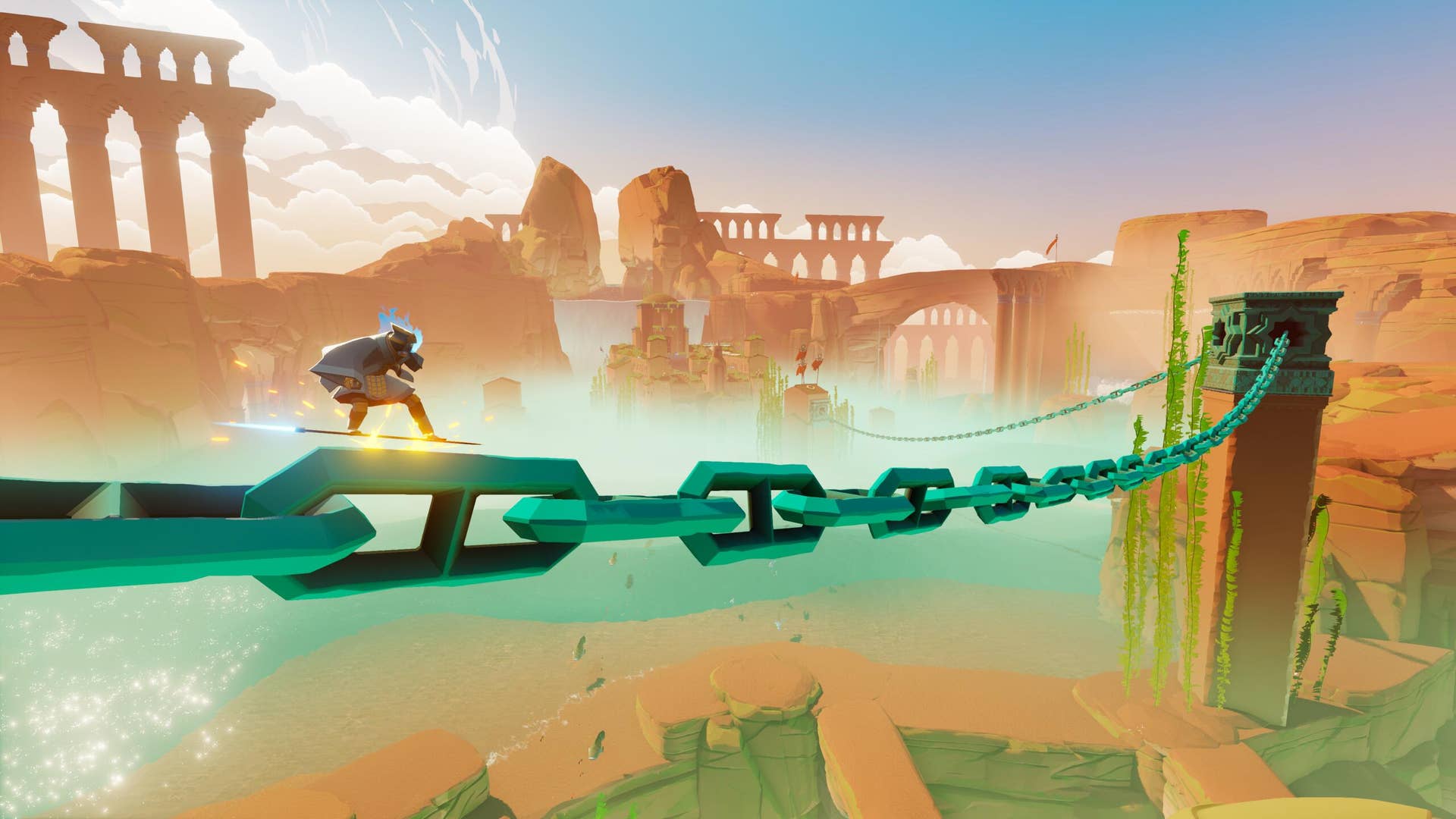
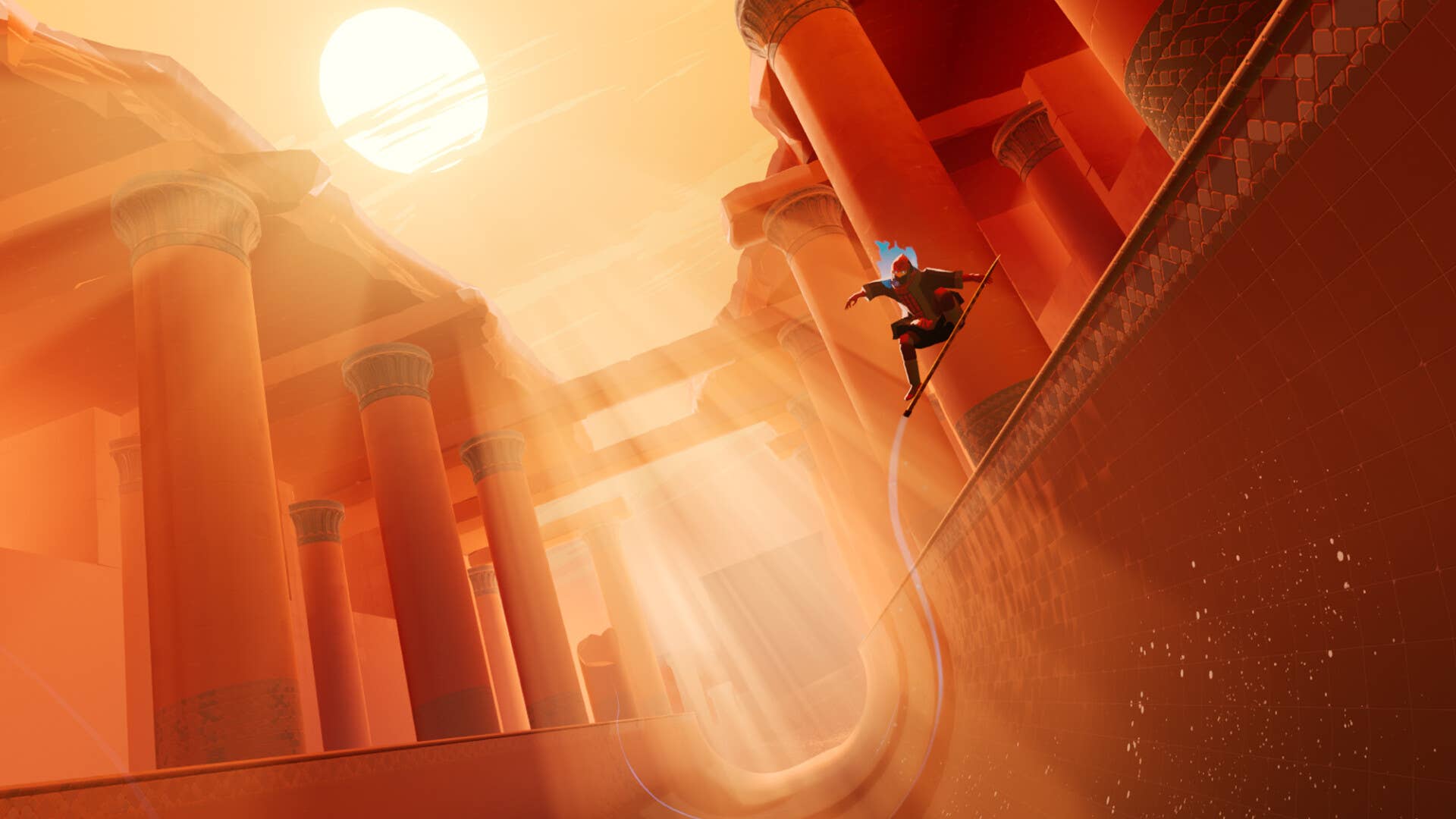
The sport, which sees the participant surf-gliding throughout rolling dunes and icy mountains, has been met with a heat vital reception. Eurogamer awarded it five stars, whereas GamesRadar referred to as it “concurrently exhilarating and meditative”, and the PlayStation 5 model of Sword of the Sea at present boasts a ‘typically favorable’ rating of 88 on Metacritic.
Whereas the reference to the firm’s earlier video games is throughout Sword of the Sea, for inventive director Matt Nava – who co-founded Large Squid in 2013 – this launch additionally marked an essential homage to Thatgamecompany’s Journey, on which he served as an artwork director.
“What I am actually joyful about is that the messaging has been clear and folks have understood the way it’s related, and that they’ve reacted in a method that’s optimistic about that. That is very satisfying,” Nava says, smiling over our video name.
Similarities between Journey and Sword of the Sea, nonetheless, prolong past their shared love for hyper-smooth motion and ambiguous storytelling.
“It is unbelievable that Sony has a devoted group of folks that basically care about the inventive facet of the medium”
Whereas the growth prices of Sword of the Sea by no means pushed the studio to chapter, like Journey did with Thatgamecompany, each tasks had been in the end saved by Sony’s belief in the course of (together with some self-funding in the latter case).
“We would not be right here with out them, even earlier than this recreation,” Nava remarks. “However on Sword of the Sea particularly, we had been in a position to work with [Sony] instantly. Midway by growth – because it normally goes – you want just a little additional cash to get it out the door; issues take longer than you suppose [they will] and also you want that additional funding.”
The much-needed monetary lifeline emerged in the type of PlayStation Indies, one of Sony’s many initiatives devoted to “highlight and assist the greatest of the greatest indie video games.”
Since the program’s launch in 2020, greater than a dozen indie titles, together with Pacific Drive, Recompile, and Maquette, have acquired assist and funding from Sony.
“It is simply unbelievable that Sony has a program like that. [That] this large, highly effective firm has a devoted group of folks inside that basically care about the inventive facet of the medium,” says Nava.
Changing into a PlayStation Indie
This perception in the inventive imaginative and prescient of Large Squid “by a pair of people” over at PlayStation Indies, then, was the push that helped Sword of the Sea to see the gentle of day.
“They had been in a position to assist us by collaborating with the PlayStation Plus group. They’re totally different components of Sony, however they communicated with one another, and so they had been in a position to say, ‘Okay, we’ll pitch in. We’ll cowl this.’,” Nava explains.
Getting backing from the PlayStation Plus division, which requires so much “of planning and shifting round [in order to] ensure that it really works with the different” titles, Nava provides, would not come with out sure obligations.
As half of Large Squid’s cope with PlayStation, Sword of the Sea was to develop into a PlayStation Plus day-one title, as an alternative of being printed independently.
Based on the inventive director, buying and selling a measure of independence for that vital polish time is usually a double-edged sword.
“On the one hand, you are freely giving the recreation without spending a dime to all these people who find themselves already subscribed. However at the identical time, far more persons are taking part in it – you are getting extra eyes on the recreation. And that is tremendously helpful as effectively,” he says. “You by no means know the way that stability goes to play out for you and your particular recreation. It could actually show you how to, [or] it may well damage you.”
Though there’s little info on whether or not all PlayStation Plus day-one video games get the identical deal, Sword of the Sea was nonetheless self-published with extra publishing on Sony’s finish. “It is type of arduous to clarify,” Nava begins.
“Technically, we self-published this recreation. That permit us instantly management the storefronts and have so much of management in the advertising and marketing in a method that we hadn’t completed earlier than.”
Whereas he didn’t specify precisely how a lot time this deal afforded Large Squid’s roughly 20-person group, Nava calls the partnership with PlayStation Plus a “studying course of.”
“It was actually great for us as a result of that additional management helped us in the closing moments of getting this recreation out the door. We had been in a position to do some loopy tips and get some fixes at the final second. And, man, it saved the recreation.”
Working in opposition to the clock
There’s maybe no saying in the recreation growth biz possibly erroneously attributed to Shigeru Miyamoto’s famous, “A delayed recreation is ultimately good, however a foul recreation is dangerous endlessly.”
And whereas exceptions like No Man’s Sky and Cyberpunk 2077 show that years of post-launch work can work as a redemption arc, most smaller studios – Large Squid included – don’t have that sort of luxurious. They must make each second depend, even when time works in opposition to you.
For Nava, this rings true even after a decade-plus expertise main a studio and three efficiently printed titles.
“Each recreation I’ve labored on, it has been an act of religion from everyone concerned to consider that it’s going to develop into nice. At the starting, it is so easy: you do not have all the components, and also you’re type of saying, ‘Okay, it’s important to think about [how] to fill in the blanks.’ After which at the final second, you get the entire factor for the first time – you get to see all of it collectively.
“Now [that] you may see the entire expertise, that allows you to tune it up holistically. And [during] that closing interval, you may [make] large modifications. You possibly can manipulate the broader expertise with the data of how the recreation feels altogether.”
Nava continues: “You are additionally at the peak of your capability to construct the recreation. You know the way to construct this recreation since you figured that out. You are fully empowered. However then the solely factor you do not have is any time. It’s a must to struggle to get time at the finish, in order that when you could have that data and holistic understanding, you can also make these sweeping modifications.”
One of these modifications, Nava recollects, was fixing Sword of the Sea’s cutscenes that had been at all times postpone as a result of of extra speedy polish work on the recreation’s mechanics.
“For a really very long time, the fog in these scenes [were] all the unsuitable color,” he remembers. “There is a scary scene, and it is purported to be misty and spooky-looking. However for a very long time, it was very clear. It regarded like a beautiful sundown.”
Naturally, Nava likens the closing push to achieve “the degree of polish [they] all dreamed of” to Journey, whose closing, long-overdue model left three of 25 play testers crying, in accordance with ThatGameCompany’s Jenova Chen (who just lately spoke with GamesIndustry.biz about firm’s transmedia targets).
“With Journey, we had been ready to try this. However that recreation was tough till we did that. It was a chore. After which it lastly got here collectively in a very nice method. Sword of the Sea bought the time like that, too, [but] simply barely,” Nava remembers. “Simply coordinating that final push… it was so much that we bought it.”
Rolling with the punches
Navigating ‘co-publishing’ with PlayStation after bringing the studio and the mission again from the monetary brink was an essential lesson for Nava. However so was adapting to a post-COVID business, which fully reshaped how each AAA and indie studios round the world approached making video games.
“We had just a little bit of expertise working remotely,” he says, referencing the closing stretch of The Pathless’ growth.
“However beginning a mission could be very totally different than ending one. While you’re ending it, everyone is aware of precisely what they’re making an attempt to do, and so they have a really clear deadline. The start… I do not know what this is but. That was the place we needed to be taught simply how we type of ideate and give you new concepts collectively if we’re not in the identical room.”
Whereas Nava and the group had been in a position to full Sword of the Sea below one roof, for a lot of Large Squid staff, beginning a brand new mission in the midst of the pandemic was simply as unfamiliar and terrifying because it was for the recreation’s inventive director.
It wasn’t merely a matter of adapting to new instruments or including Zoom conferences to make up for the lack of in-person brainstorming periods – it got here right down to Large Squid adjusting to the new actuality of distant work.
“It took us some time to determine that out. It got here right down to [the] method we considered the work. How we made certain everyone had one thing to do and they might, even with out having to speak to anyone, know the place to go subsequent. [We] made certain everyone has the recreation plan,” says Nava.
In some ways, the present state of affairs in the video games business is extra terrifying than it was at the begin of Sword of the Sea’s growth in 2020, in the midst of a pandemic. In accordance video game artist Farhan Noor’s layoff tracker, there have been an estimated 38,000 layoffs in the business since the begin of 2022: so how is that this business turbulence affecting Large Squid’s subsequent steps?”
“It is one thing that we’re at all times fascinated about,” Nava admits. “The method that you’ve at these sorts of studios is that you simply get that funding, you spend all of it as you make the recreation. And now, at the finish, the recreation hasn’t made sufficient gross sales but to usher in money as a result of all of the funding folks must recoup first.
“So there’s this little hole the place you are like, ‘How will we hold this present on the street?’ Is there one other technique to strategy this in order that we are able to obtain this factor that we’re doing extra sustainably?”
He concludes: “What’s essential to me is that this core group that we have managed to maintain collectively. I’ve simply bought to maintain these folks collectively. So I am making an attempt to determine find out how to make it work. And each time we do it, I take into consideration what was actually powerful about that.”