.jpg?resize=1920,999999 "Xbox and Windows are no longer at arm’s length | Opinion")
When Microsoft first introduced its intention to enter the video games console market virtually precisely 25 years in the past, there was a widespread assumption that the Xbox would primarily be a stalking horse for the Windows working system.
It appeared like a strategic transfer designed to make sure that, as highly effective multimedia units took over individuals’s residing rooms, they’d be an extension of the Windows PC moderately than the formidable new ecosystem which Sony was attempting to assemble across the PlayStation.
The type of the unique Xbox appeared to substantiate that assumption: constructed round comparatively customary PC parts, its working system was a particularly stripped down model of Windows, with video games being constructed on a variation of Windows’ DirectX frameworks.
Over time, nevertheless, the expectation that the Xbox and Windows would primarily turn into joined at the hip by no means fairly got here to go. Bits and items of Xbox’s branding and providers choices have been constructed into Windows, however they by no means totally overlapped – not least, maybe, as a result of the battle for the lounge that Microsoft had anticipated by no means actually materialised, with PlayStation finally specializing in being extra of a pure gaming play, and Microsoft’s most critical flirtation with multimedia performance virtually fully sinking the Xbox One console.
1 / 4 century on from the unique Xbox, nevertheless, Microsoft lastly appears decided to deliver Xbox and Windows collectively in a manner that makes them kind of right into a contiguous platform.
We had a number of bulletins over the previous couple of weeks that do not fairly quantity to an unveiling of the following era of Xbox, however do at least level the best way to what that can appear like. We all know that Microsoft has inked a long-term cope with AMD to proceed offering parts for its consoles – affirmation, if any have been wanted, that it is fairly critical about staying within the {hardware} enterprise.
We additionally know, nevertheless, that the corporate is trying at offering Xbox providers and compatibility to handheld gaming units from third-party corporations in addition to constructing its personal handheld Xbox, strongly suggesting that it envisages a future for Xbox that encompasses each Microsoft {hardware} and third-party licensed {hardware}.
.jpg?width=1920&height=1920&fit=bounds&quality=70&format=jpg&auto=webp "Xbox and Windows are no longer at arm’s length | Opinion")
Most tellingly of all, we additionally acquired a affirmation that the next-gen Xbox goes to be a way more versatile machine than any earlier console – it is not going to be locked to a single retailer, in line with Xbox president Sarah Bond, who additionally pretty clearly said that she sees the position of the next-gen Xbox being about making certain Windows’ dominance of the gaming market.
The period wherein Xbox and Windows have been held at arm’s length from each other is seemingly over; Xbox units are going to be very explicitly thought of as a part of the Windows gaming ecosystem in future.
That each one of this has been revealed in a considerably piecemeal method does appear to recommend that Microsoft continues to be attempting to ease its core followers into this new actuality, introducing new facets of the technique steadily to keep away from the impression that it is pivoting away from console gaming fully.
If the corporate is critical about Xbox units operating Windows, then it additionally must be critical about how that model of Windows shall be optimised and stripped down
Some individuals will nonetheless draw that conclusion, and truthfully, it isn’t fully unfair – it simply is determined by the way you outline a “console”, as a result of the following era of Xbox {hardware} is more likely to be essentially the most expansive but, comprising each handheld and residence console fashions, but in addition more likely to be essentially the most much like a variety of gaming-focused Windows PCs.
Does an Xbox interface operating excessive of Windows flip the machine right into a console? Most likely not. However however, does quibbling over the definition of a console really matter to very many individuals?
Nonetheless, there are causes to be involved about this strategy, each for builders and for shoppers. An Xbox ecosystem encompassing many units with many various specs, created by many various corporations, is a tough shifting goal for builders – very totally different from the static goal of a console, and even the bifurcated goal that Microsoft has introduced with Xbox Collection X and S.
That is not an insoluble downside, but it surely’s an issue no much less, particularly if some shoppers find yourself feeling like their Xbox makes them a second class citizen in comparison with another person’s Xbox.
Arguably the larger concern is that Windows does not precisely have a sterling repute for gaming efficiency on lower-end techniques – like handheld consoles.
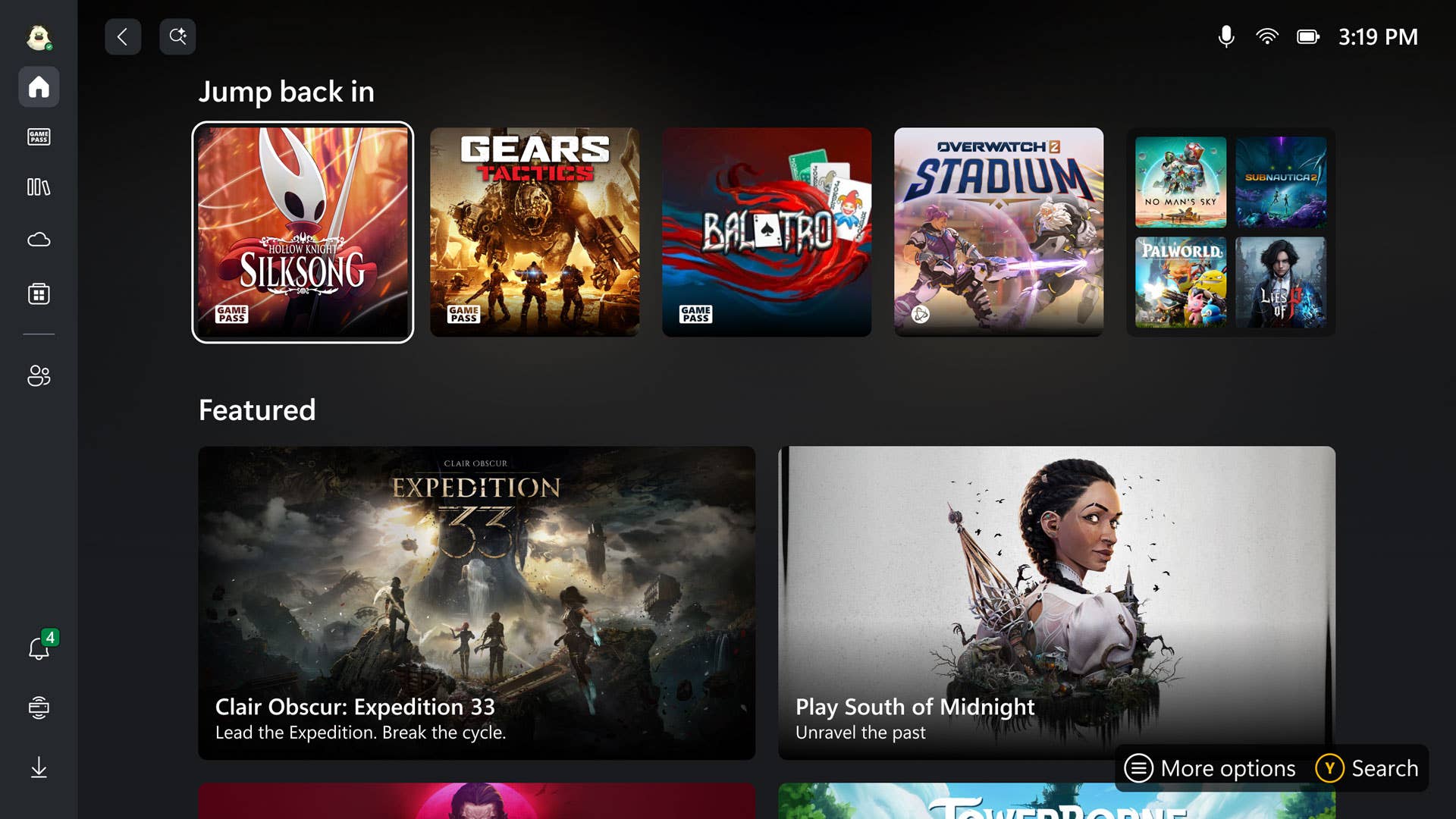
Just a few weeks in the past we got confirmation that putting in Valve’s Steam OS on handheld gaming units may massively enhance efficiency over having Windows on them – that story was very broadly picked up and spurred a good bit of criticism of how Microsoft has approached tailoring Windows for these units, which makes the timing of this most up-to-date announcement a bit awkward.
If the corporate is critical about Xbox units operating Windows, because it appears to be, then it additionally must be very critical about how that model of Windows shall be optimised and stripped down.
Units that chew by battery life, drag down body charges, and run uncomfortably sizzling due to a heavy desktop working system draining their sources will discover it laborious to compete in a market towards extra nimble opponents, whether or not they’re powered by Valve’s gaming-centric OS or just within the type of Nintendo’s Change 2.
Nonetheless, it is laborious to argue that Microsoft’s strategy will not work, for one key motive – it robotically has the buy-in of one of many world’s greatest and most essential publishers.
Earlier than Microsoft spent the most effective a part of $100 billion shopping for out key publishers and builders, a transfer like this is able to have been dangerous, forcing the corporate to go cap in hand to 3rd social gathering publishers to attempt to drum up assist. Now, though it isn’t with out inherent danger, it is assured to have a gradual stream of main video games for the brand new Xbox units and for the Sport Move subscription service that can unite them. The software program downside has been solved with some very dramatic chequebook strikes, and that modifications the aggressive panorama in a manner that has little to do with {hardware} design or technique.
As we await extra particulars of what these new Xboxen will appear like, nevertheless, one main strategic query stays very urgent: who does Microsoft really see as its rivals on this house? Maybe it is Sony, because it has traditionally been. Extra seemingly it is Valve, whose Steam OS and Steam retailer poses a real aggressive risk to some core components of Microsoft’s enterprise.
But competitors will not be a easy factor on this house any extra. Microsoft’s publishing enterprise is intently tied to the PlayStation, making a symbiotic hyperlink between the businesses. And though it was circuitously said, the implication of this week’s bulletins was that Valve’s Steam retailer may really be obtainable on future Xbox units.
Maybe Microsoft’s actual technique is to not have any simple rivals – to deal with the Xbox and its publishing enterprise as a chance to elevate all boats and revenue in many various methods. In that case, it is that strategic imaginative and prescient, greater than every other facet of the following Xbox, that might actually reshape the business for the long run.